Cleaning exhaust by treating the air that goes in.
The Plasmoid X system fits between a diesel engine's air intake and its exhaust. It charges the incoming air, warms it with heat taken from the outgoing exhaust and feeds it to the turbo.
Six stages, from air in to exhaust out
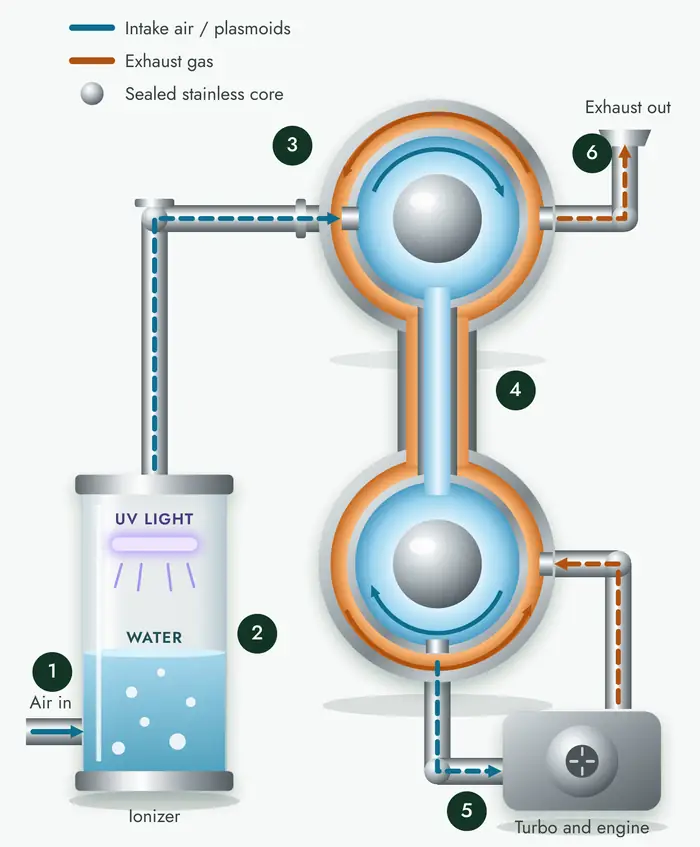
Air in
Fresh air is drawn into the system instead of going straight into the turbo.
Ionizer
The air bubbles through water and passes under UV light, which turns it into stable plasma, or plasmoids. Filters keep the water out of the engine.
Swirl chamber
The plasmoid air spirals through the inner chamber of two linked stainless spheres. A sealed core sphere in each one keeps it swirling.
Counter-flow heat exchange
Hot exhaust spirals the opposite way through the outer chamber and passes heat through the wall into the plasmoids.
Into the engine
The warmed plasmoids feed the turbo inlet, where they are designed to convert excess carbon and nitrogen into oxygen.
Cleaner exhaust out
The exhaust, now cooler, leaves through the outer chamber and out of the boat.
Better at higher loads. A harder-working engine runs hotter and moves more air, and both help the system produce plasmoids.
SCR and particulate filters clean up after combustion
Conventional SCR and diesel particulate filter systems trap particulates and dose chemicals to neutralize NOx in the exhaust. They work, but they are bulky, heavy and need regular servicing.
Plasmoid X treats the air before it goes into the engine, so there is no filter media to clog or replace.
Cleaner, more efficient engines
Cleaner exhaust
Carbon, NOx and SOx are dealt with at the source, so there is nothing to trap and dispose of.
Better fuel economy
More complete combustion means less fuel burned to do the same work.
Longer engine life
Less soot means less abrasive wear on cylinders and internals over time.
Want the technical detail for your engineering team?
Get in touch and we'll walk you through the retrofit process, installation requirements and what to expect for your vessel.